Framekit templates
Start from a designer-made template
 Use template
 Use template
 Use template
 Use template
 Use template
 Use template
 Use template
 Use template
People do not go looking for Gamma alternatives because Gamma is bad. They go looking because of one wall. You arrive delighted, generate five or six decks, and then hit a limit that is not a paywall in the usual sense.
The 400 credits Gamma gives you do not refresh. They are a one-time grant, so the free plan does not expire on a date, it expires the moment you use it up.
Then there are the quieter complaints, and they are really one complaint about format. Gamma builds cards that scroll and reflow like a web page.
That reads beautifully on a phone and awkwardly everywhere a presentation actually happens: letterboxed on a meeting-room screen, split mid-thought across the pages of a PDF, or flattened into a PowerPoint file that no longer looks like what you built.
On top of that, every Gamma deck looks like a Gamma deck until you fight the defaults.
The tool is not the problem. The credit model and the card format are.
A Gamma alternative is any tool that produces a presentation from a prompt or an outline without Gamma's non-refreshing credit pool, its scrolling-card format, or its lossy export path. Most alternatives fix one of the three and charge for the privilege.
The best Gamma alternative in 2026 is Framekit Slides, because it keeps the part of Gamma people like, AI that drafts a slide from a plain description, and hands back a real 16:9 slide deck you can rearrange by hand, present full screen, share as a link, and export to PDF on every plan including free.
The trade-off is file hand-off: its PowerPoint export is picture-based and Pro-only, so anyone whose client edits the .pptx should look at Plus AI instead.
Canva is the pick if a refreshing monthly AI allowance is all you need, Pitch is the answer for a team with its own template system, and Google Slides is the free choice if AI drafting was never the point.
Full disclosure: Framekit is our own product and it is ranked first below, so weigh that. We ran the same brief through the seven competitors, we link to every one, our own review sticks to what Slides ships rather than claiming a test result, and each competitor review says where it beats us: Gamma still writes a better-argued first draft, Plus AI and Canva hand over editable PowerPoint files, and Pitch and Storydoc tell you who opened a deck, which Framekit does not.
In September 2026 we re-verified Gamma's free-credit rules and the Plus AI and Pitch price lists against their own pages, and re-ranked the list after Framekit shipped Slides; the August edition had Framekit last because it made web pages rather than decks, which is no longer true.
How We Tested 8 Gamma Alternatives
We gave every tool the same one-paragraph brief that we had given Gamma: a twelve-slide rebrand pitch for a mid-sized coffee roaster, including a market slide with a chart, a three-tier pricing slide, and a closing ask.
We accepted the first generation without editing, then measured the four things that push people off Gamma. Framekit is our own product, so its review describes what Slides ships rather than reporting a measured result.
First, credit economics: what the free tier really allows and whether it refreshes. Second, format: whether the result is a fixed slide that holds its layout on a projector and in a PDF, or a card that reflows.
Third, house style: whether the output is identifiable as coming from that tool. Fourth, export: what survives becoming a PDF or a .pptx.
Measured findings are things we generated and counted. Verified findings come from vendor pricing and documentation, checked in August 2026 with the Gamma, Plus AI and Pitch figures re-verified in September 2026, and cover every price and credit allowance below. Community sentiment is labelled in the sentence where it appears.
The weighting
Credit economics is 25%, because it is the reason most people start reading this. Draft quality is 20%. Editing speed is 20%, since every AI generation needs work and what matters is how fast you can do it. Slide format is 20%. Export fidelity is 15%.
Slide format is the weight that happens to favour our own product, so here is why it sits at a fifth: it is the complaint that costs you in the room.
A card deck that letterboxes on the client's screen, or a PDF where the pricing table breaks across two pages, is a problem you discover while presenting, which is the worst possible moment to discover anything.
Score it the way this guide did in August, with slide format left out and credit economics at 30%, and Canva takes first place while Framekit sits third.
What the Eight Alternatives Showed
- 6 of the 7 competitors refresh their AI allowance monthly on at least one plan rather than granting it once, which is the single biggest structural difference from Gamma.
- Only Decktopus publishes a credit-to-slide ratio: 750 credits a month covers roughly 150 slides, or about 5 credits a slide. Applied to Gamma, 400 one-time credits is about six twelve-slide decks in total.
- 6 of 8 hand over a .pptx another person can edit, Pitch only on paid plans. Storydoc has no slide-format export, and Framekit's PowerPoint export turns each slide into a picture.
- 2 of 8 cost less per year than Gamma Plus at $108: Google Slides at $0 and Framekit Starter at $84 on annual billing. The other six cost more, so Gamma is genuinely cheap for what it does.
- 7 of 8 put your content on a fixed slide canvas. Storydoc is the exception, because it deliberately copies the scrolling format Gamma uses.
Quick Comparison: 8 Gamma Alternatives
Weighted on the five criteria above. Framekit leads while scoring 6 out of 10 on export fidelity, the lowest mark in our top five, because its .pptx is picture-based. Canva sits a tenth behind and beats it on that column outright.
| Tool | Fixes which Gamma complaint | AI allowance | Export fidelity | Cheapest paid, per year | Rating |
|---|---|---|---|---|---|
| Framekit | Card format, creative layout | Unlimited decks, every plan | 6/10 | $84 | 9.1/10 |
| Canva | Credits, editing speed | Refreshes monthly | 9/10 | $144 | 9.0/10 |
| Plus AI | Native PowerPoint output | Refreshes monthly | 10/10 | $120 | 8.5/10 |
| Beautiful.ai | Layout consistency | Refreshes monthly | 8/10 | $144 | 8.1/10 |
| Pitch | House style, team libraries | Refreshes on paid plans | 8/10 | About EUR 120 | 8.0/10 |
| Google Slides | Cost and file fidelity | None built in | 9/10 | $0 needed | 7.9/10 |
| Decktopus | Transparent credit maths | Refreshes monthly | 7/10 | $119.88 | 7.3/10 |
| Storydoc | Read analytics and interactivity | Refreshes monthly, tightly | 4/10 | $237.60 | 7.0/10 |
Competitor allowances and prices come from each vendor's own published plans, read in August 2026; Gamma, Plus AI and Pitch were re-checked in September 2026.
Framekit's row lists its deck limit rather than an AI credit figure, because we do not publish credit counts for our own product; judge that on the free plan yourself.
The Credit Maths Gamma Does Not Publish
In one lineusing the only published credit-to-slide ratio in the category, Gamma's free plan is about six decks in total and Gamma Plus is about sixteen a month, which reframes both the free tier and every alternative's pricing.
Decktopus states on its pricing page that 750 monthly credits cover roughly 150 slides. That is 5 credits a slide, and it is the only public number of its kind.
Applying it as a benchmark produces the first honest comparison of these free tiers.
| Plan | Allowance | Refreshes | Twelve-slide decks it plausibly covers |
|---|---|---|---|
| Gamma free | 400 credits | No | About 6, then permanently over |
| Gamma Plus | 1,000 a month | Yes | About 16 a month |
| Gamma Pro | 4,000 a month | Yes | About 66 a month |
| Pitch free | 100 credits | No | About 1 to 2 |
| Pitch Plus | 500 a month | Yes | About 8 a month |
| Decktopus Pro | 750 a month | Yes | About 12 a month |
| Canva free | ~200 standard AI uses a month | Yes | Metered by use, not slides |
| Storydoc Starter | 25 AI text credits a month | Yes | The tightest paid allowance here |
Treat these as orders of magnitude, since only Decktopus publishes the ratio and image generation costs more than text everywhere.
Run this on yourself. Take the number of decks you expect to make this year, add half again for the versions you will redo when the first generation misses, and multiply by 60 credits.
If the result is under 400, Gamma's free plan is genuinely free for you. If it is over, you are comparing $108 a year against the alternatives below, not $0 against them.
1. Framekit: Best Gamma Alternative for Real Slides

Our rating: 9.1/10
Framekit is an AI website builder that also includes Slides, a deck tool built for pitches, treatments and lookbooks, and Slides is the answer to the Gamma complaint nobody puts in the search box: the output was never really a presentation.
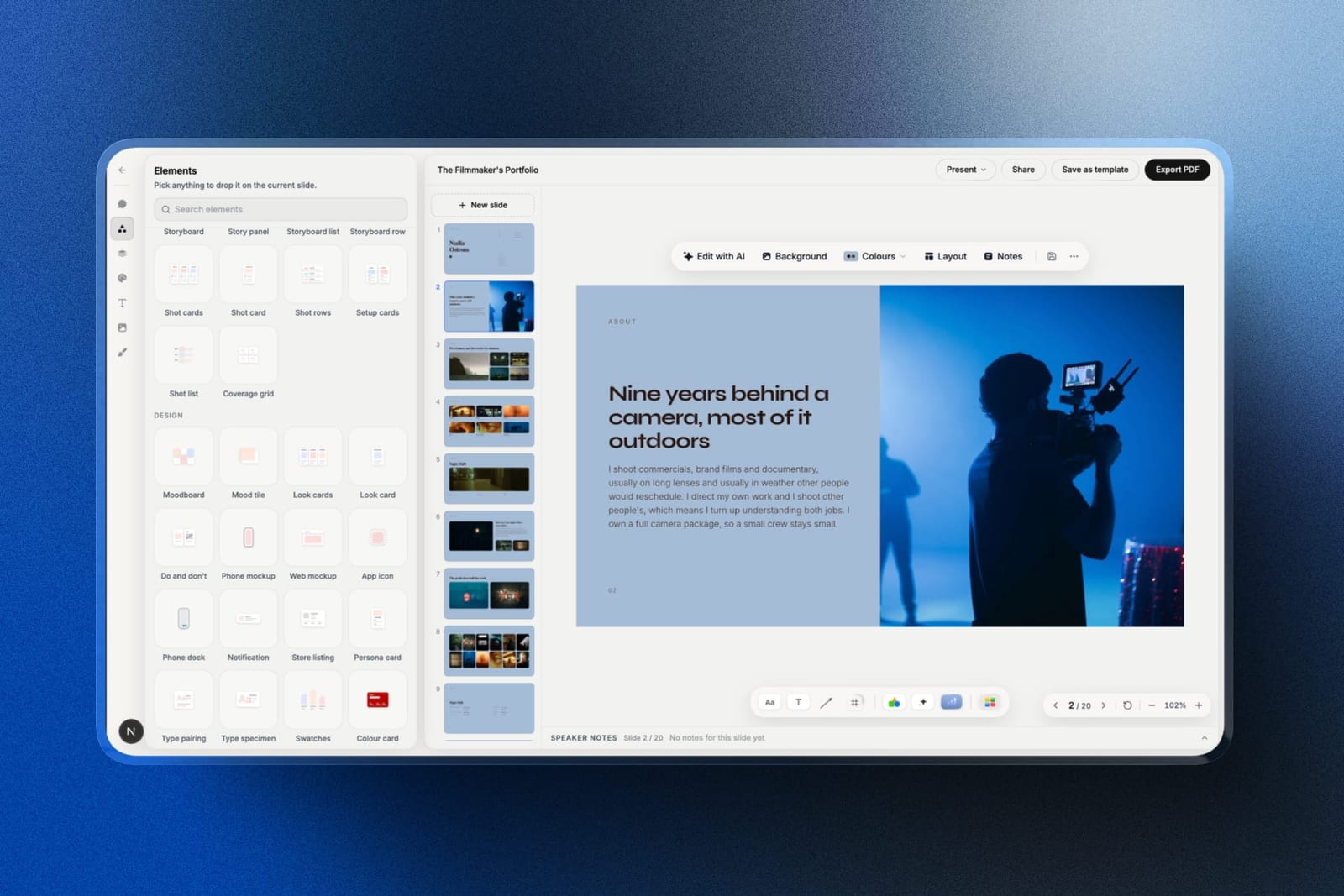
You describe what a slide has to say, the AI writes it and places it on a fixed 16:9 slide, and from that point every block is yours to drag, resize, retype or delete. Nothing reflows behind your back.
Take the coffee roaster brief as an example of why that matters.
A three-tier pricing slide is one fixed page, so it exports as one PDF page and fills the screen in full-screen mode, where a long Gamma card breaks wherever the page happens to end.
For the market slide you can drop in the chart element, type the figures, and slide the whole block left by hand to make room for a pull quote, the kind of nudge that in Gamma means arguing with the card layout.
Best forDesigners, photographers, filmmakers and studios who liked how fast Gamma drafts but need a deck that presents in a room and prints to PDF without surprises.
Key features:
- AI drafts any slide from a description, and every element stays hand-editable afterwards
- Creative building blocks built in: shot lists, storyboard rows, moodboards, look cards, swatches, type specimens, phone and web mockups, and charts
- Your own fonts and colours applied across every slide, with speaker notes on each one
- Present full screen from the browser, share a link, or export a PDF on every plan
- Unlimited decks on every plan, in the same account as your website, client galleries and store
The real numberStarter costs $7 a month billed yearly, $84 a year, which is about $12 less than Gamma Plus and unlocks the template library, custom fonts and removal of the "Made with Framekit" badge.
The free plan already presents full screen and exports PDFs, but every free deck carries that badge, which matters if the pitch goes to a paying client.
The standout detailfor a rebrand pitch, the swatch and type specimen elements let you show the proposed palette and typeface as designed objects rather than as a screenshot pasted from another app. That is the moment a creative client starts nodding.
The gotchaa client's brand team cannot open your deck and edit it in PowerPoint. The .pptx export is Pro and up, capped at 60 slides, and turns each slide into a picture.
There is also no password on a shared deck link, no read analytics, no live multi-cursor co-editing, and no importer for a Gamma deck, so moving over means pasting your outline and redrafting.
Skip it ifyour deliverable is an editable file someone else finishes, you need to know who opened the link, or three colleagues edit the same deck at once. Plus AI, Pitch or Google Slides fits each of those better.
Verdict: Framekit is the Gamma alternative for people who want the AI speed and a proper slide at the end of it. If your decks are presented, printed or judged on their design, start here; if they are handed off as files, do not.
2. Canva: Best for a Refreshing AI Allowance
Our rating: 9.0/10
Canva fixes the complaint that sends most people looking. Its AI allowance refreshes every month rather than draining permanently, so the tool does not stop working in week three.
On the free plan that is roughly 200 standard AI uses and 20 premium uses a month, which is a fundamentally different arrangement from a one-time grant.
The second fix is editing speed. Every AI generation in this comparison needed work, and Canva was the fastest place to do it. Pulling a generated slide apart and rebuilding it took under a minute; doing the same in Decktopus or Storydoc meant negotiating with a layout engine.
Best forAnyone leaving Gamma because the credits ran out, who is willing to finish the deck themselves.
Key features:
- Magic Design generation into Canva's own template system
- An AI allowance that refreshes monthly instead of a one-time pool
- The largest well-designed template library in the category
- Exports to PDF, PPTX, MP4, and GIF without flattening a scroll layout
- Brand Kit on Pro for fonts, colours, and logos across every deck
The real numberthe free plan is genuinely free with a monthly AI refresh. Pro is $18 a month or $144 billed annually, about $12 a month, and Business is $25 per user a month. Against Gamma Plus at $108 a year, Canva Pro costs $36 more and removes the credit anxiety entirely.
The gotchapremium stock assets come back watermarked in exports, and the mark is faint in the editor. Since AI generations like choosing premium assets, the usual discovery point is the finished PDF.
What reviewers say elsewhereCanva carries a 4.7 out of 5 rating on G2 from more than 6,800 reviews, which is the largest verified review sample of any tool in this comparison.
Pros:
- A monthly-refreshing allowance instead of a pool that empties
- The fastest tool here for repairing an imperfect generation
- Exports that arrive in the format people asked for
Cons:
- Generation quality is behind Gamma on structure
- Premium assets watermark the export
- Custom brand fonts require Pro
Skip it ifyou wanted AI to do the thinking. Canva's generation is a starting layout, not an argument, and Gamma is genuinely better at that specific job.
Verdict: Canva is the right move for anyone leaving Gamma purely over credits, because it swaps a better generator for a better editor and a saner pricing model, and it beats our own pick outright when the finished file has to be an editable .pptx. Designers comparing their wider toolkit should read our best AI tools for designers roundup.
3. Plus AI: Best If You Need a Real PowerPoint File
Our rating: 8.5/10
If your reason for leaving Gamma is the export, Plus AI solves it by removing the export entirely. It generates inside Google Slides and PowerPoint, so what comes out is already a native file that a client's brand team can open and edit without conversion.
The generated structure was the closest to Gamma's of anything here, and the design ceiling is whatever the host application can render, which is lower than Gamma's by some distance.
Best forPeople whose decks are edited downstream, or whose clients only accept .pptx.
Key features:
- Generates and edits slides inside Google Slides and PowerPoint
- No export step at all, because the output is already the file
- Rewrites and reformats existing slides in place
- Custom templates and themes the generation respects
- A 7-day trial including 1,000 AI credits
The real numberBasic is $10 per user a month on annual billing, or $15 monthly; Pro is $20 or $25; Team is $30 or $40, per Plus AI's pricing page.
Budget it as an addition: Basic at $120 a year plus Microsoft 365 Personal at $99.99 is about $220 against Gamma Plus at $108.
The gotchayou are paying twice. Plus AI has no standalone product, so the true cost is its subscription plus whichever suite hosts it, which more than doubles the Gamma bill it replaces.
Pros:
- The output is a native file, so nothing is ever flattened
- Structure quality closest to Gamma's of anything tested
- Colleagues can edit it with no new accounts
Cons:
- Costs stack on top of an existing suite subscription
- Design quality is capped by PowerPoint or Slides
- No value at all if you leave those tools
Skip it ifnobody downstream edits your files. You would be paying a compatibility premium you never use.
Verdict: Plus AI is the correct answer if the export was your complaint, and an expensive one if it was not.
4. Beautiful.ai: Best If Layout Was the Real Problem
Our rating: 8.1/10
Some people leave Gamma because the generated layouts drift once they start editing. Beautiful.ai answers that specifically: its Smart Slides rebalance themselves as content changes, so a slide cannot end up badly spaced no matter what you do to it.
The cost is control. Where Gamma gives you a house style you can fight, Beautiful.ai gives you a layout engine you cannot, and when it disagrees with you there is no clean override.
Best forNon-designers whose complaint about generated decks is spacing rather than words.
Key features:
- Smart Slides with over 300 self-balancing layouts
- AI generation constrained to those layouts
- Custom branding applied across an entire deck
- Dynamic data visualisations linked to live sources
- Viewer analytics on shared links
The real numberthere is no free plan, which is a sharp change from Gamma's 400 free credits.
Pro is $12 a month billed annually, Team is $40 per user a month annually or $50 monthly, and a One-Time Project licence is $45, per Beautiful.ai's pricing page.
The 14-day trial requires a card.
The gotchathe two-seat cliff. One seat is $144 a year; two seats is $960, which is a 6.7 times jump and by far the steepest step in this comparison.
Pros and consthe most consistently well-spaced output here and a fair $45 single-project licence, against no free plan, a card-gated trial, a layout engine that cannot be overruled, and a punishing second-seat price.
Skip it ifyou have design opinions, or you plan to add a collaborator.
Verdict: Beautiful.ai is a narrower product than Gamma that is better at one thing. Buy the project licence rather than the subscription unless you present constantly.
5. Pitch: Best for Escaping the House Style
Our rating: 8.0/10
The complaint that a Gamma deck looks like a Gamma deck has one real fix: generate into your own templates instead of a vendor's. Pitch does exactly that, with shared template libraries a whole team can draw from, so the AI fills your house style rather than imposing one.
It also has the best link controls in this comparison, with tracking, expiry, and per-recipient access, which matters if your decks go to clients rather than colleagues.
Best forStudios that want AI drafting inside their own visual system.
Key features:
- AI drafting into shared, custom templates rather than generic ones
- Advanced links with tracking, expiry, and per-recipient control
- Teamspaces and shared rooms for organising decks by client
- PowerPoint export and custom fonts on paid plans
- Real-time collaboration in a modern editor
The real numberthe free plan gives one seat, unlimited presentations, 100 one-time AI credits, and two external guests.
Plus is EUR 10 a month on annual billing with 500 refreshing credits, Team is EUR 15, and Business is EUR 20 with 750 credits, per Pitch's pricing page.
The gotchaPitch's free AI grant is 100 one-time credits, which is a quarter of Gamma's and equally non-refreshing. If the credit model is what you are escaping, only the paid tiers actually escape it.
Pros and consgeneration into your own templates plus the best link controls at this price, against a free AI grant smaller than Gamma's, two external guests on free, and prices quoted in EUR.
Skip it ifyou work alone on varied one-off decks.
Verdict: Pitch is the right alternative when the house style is the complaint and you have a house style of your own to replace it with.
6. Google Slides: Best If AI Was Never the Point
Our rating: 7.9/10
A surprising number of people who try Gamma conclude that what they wanted was not AI drafting but a faster start, and that a decent template plus twenty minutes gets them there without a credit balance. For those people the answer is the most boring tool on this page.
Google Slides has no meaningful built-in generation, costs nothing, never runs out, exports cleanly, and collaborates better than every other tool here. Its design ceiling is low and it never surprises you.
Best forAnyone who has decided the credit model is not worth managing.
Key features:
- Free and unlimited with any Google account
- The most reliable .pptx round trip of the eight
- Real-time co-editing and threaded comments
- Version history that restores a single slide
- Add-ons, including Plus AI, if you want generation later
The real number$0 permanently, or $7 per user a month on a company domain through Google Workspace Business Starter, per Google's published pricing.
Against Gamma Plus at $108 a year, staying free saves the whole subscription and costs you the drafting speed.
The gotchathe design gap is real and it is why you tried Gamma in the first place. Slides will not close it, and pretending otherwise is how people end up back where they started.
Pros and consfree forever with no credit meter, the best collaboration and file fidelity here, against dated templates, thin type controls, and no generation without adding a paid add-on.
Skip it ifthe AI draft is genuinely saving you an hour a deck.
Verdict: Google Slides is the honest answer for people whose Gamma experiment proved they wanted speed rather than intelligence.
7. Decktopus: Best Credit Transparency
Our rating: 7.3/10
Decktopus is the only tool in this comparison that tells you what a credit buys, which is a strange thing to be a differentiator and a genuinely useful one when you have just been surprised by Gamma's arithmetic. Its 750 monthly credits are stated to cover about 150 slides.
The generated design is plainer than Gamma's, and there is no standing free plan, only a generator you can try.
Best forPeople who want a predictable monthly allowance and a straight answer about what it covers.
Key features:
- A published credit-to-slide ratio, unique in this category
- Presentations and carousels from a single prompt
- PDF, PPT, and PNG export on all paid plans
- Delivery practice with recorded run-throughs
- Version history and mobile access
The real numberPro is $24.99 a month, or $9.99 a month billed annually at $119.88 a year, including 750 credits a month; Business gives 1,000 credits per seat, per Decktopus's pricing page.
Annual Decktopus is about $12 a year more than Gamma Plus for a comparable allowance.
The gotchamonthly billing is two and a half times the annual rate, which is the widest gap in this comparison and easy to miss at signup.
Pros and consthe only published credit ratio in the category, a useful delivery-practice feature, and PPT export on every paid plan, against generic design, no standing free tier, and a punitive monthly price.
Skip it ifdesign quality is why you generate decks at all.
Verdict: Decktopus is plain, fair, and transparent. If Gamma's opacity about credits is what annoyed you, this is the direct antidote.
8. Storydoc: Best for Interactivity and Read Data
Our rating: 7.0/10
Storydoc is the alternative for people who liked Gamma's web-native format and wanted more from it. Its documents scroll, embed video, personalise per recipient, and report which section a reader stopped at, which is a genuine capability upgrade over Gamma's analytics.
It is also the most expensive option here, its templates read corporate, and its AI allowance is the tightest of any paid plan in this comparison.
Best forSales teams who send proposals and change their follow-up based on who read what.
Key features:
- Scrolling, interactive web documents rather than fixed slides
- Section-level read analytics on every share link
- Personalisation variables for per-recipient versions
- Embedded video and live data
- Version automation for sending variants of one document
The real numberStarter is $19.80 a month, billed $237.60 a year, capped at 5 active documents with 25 AI text credits a month; Pro is $36 a month, billed $432, at 30 documents, per Storydoc's pricing page.
That is roughly 2.2 times Gamma Plus for a much tighter AI allowance.
The gotchathe active-document cap counts what stays live, so archiving an old proposal to make room takes its link offline.
Pros and consthe best read analytics of the eight and genuinely interactive documents, against the highest price here, 25 AI text credits a month, and templates that need heavy overriding for creative work.
Skip it ifyou generate decks for the design rather than the data.
Verdict: Storydoc is a Gamma alternative only for people who wanted a sales instrument. For everyone else the price does not make sense.
What You Lose by Leaving Gamma
In one lineGamma is genuinely the best structural generator in this category and one of the cheapest refreshing plans, so leaving costs you draft quality and often money.
Be honest about the trade before you move.
In our testing Gamma produced the only first draft that had an argument rather than twelve slides, its mobile behaviour was better than every fixed-canvas tool here, and Gamma Plus at $108 a year is cheaper than Canva Pro, Beautiful.ai Pro, Visme Starter, and Storydoc Starter.
Six of the eight alternatives cost more per year than the thing you are leaving; only Google Slides and Framekit Starter on annual billing cost less. If your complaint is only that the free tier ended, the cheapest resolution is usually to pay Gamma rather than to switch.
Where switching genuinely pays: when you present on a screen that is not a phone, when you need an editable native file, when your team needs its own template system, or when the pitch depends on creative elements like storyboards, shot lists and swatches.
For treatments specifically, our best film treatment software comparison goes deeper.
How to Choose a Gamma Alternative
1. Did the free credits run out and nothing else annoyed you? Pay for Gamma Plus at $108 a year. It is cheaper than most tools on this page.
2. Does a client or colleague need to edit the file after you? Plus AI, which generates natively inside PowerPoint and Google Slides. If not, go to 3.
3. Do you present on a big screen, send PDFs, or pitch creative work? Framekit Slides, for fixed slides, hand editing after the AI draft, and elements like shot lists and swatches. If you mainly want a cheaper AI allowance, go to 4.
4. Do you want the AI allowance to refresh and a huge template library? Canva.
5. Is the house style the complaint, and does your team have its own? Pitch, generating into your own shared templates.
6. Is bad spacing the complaint? Beautiful.ai, ideally the $45 project licence.
7. Did the experiment prove you wanted speed rather than AI? Google Slides, for free.
8. Do you need to know who read which section? Storydoc if you liked the scrolling format, Pitch if you did not. Decktopus is the fallback if you just want a published, predictable allowance.
Visme users looking sideways at the same category will find their options priced in our roundup of the best Visme alternatives.
If what you actually need is a starting layout rather than a new application, we read the licences on twelve sources in the best presentation template sources.
Frequently Asked Questions
What is the best Gamma alternative in 2026?
The best Gamma alternative in 2026 is Framekit Slides, because its AI drafts a slide from a description and leaves you with a fixed 16:9 deck you can edit by hand, present full screen, share as a link and export to PDF on every plan.
Canva is the better choice if a monthly-refreshing AI allowance is the only thing you need, Plus AI wins when the deliverable must be an editable PowerPoint file, and Google Slides is the free option if AI drafting turned out not to matter.
Why do Gamma's free credits run out?
Because Gamma's free tier is a one-time grant rather than a monthly allowance. You receive 400 credits once, and they do not refresh, so the free plan expires by use rather than by date.
Referrals add 200 credits each, and Gamma Plus at $9 a month billed annually, $108 a year, refreshes 1,000 credits every month.
How many decks can you make with 400 Gamma credits?
About six twelve-slide decks in total. The only published credit-to-slide ratio in this category comes from Decktopus, which states that 750 monthly credits cover roughly 150 slides, or about 5 credits a slide.
At that rate a twelve-slide deck costs around 60 credits, so 400 credits is roughly six decks and then the free plan is finished.
Is Gamma worth paying for, or should I switch?
Gamma is worth paying for if your only complaint is the credits, because Gamma Plus at $108 a year is cheaper than Canva Pro at $144, Beautiful.ai Pro at $144, Visme Starter at $147, and Storydoc Starter at $237.60.
Switch when you need an editable native file, when your team needs its own template system, or when the deliverable was never a slide deck.
Which Gamma alternative has the best free plan?
Canva has the best free AI allowance among Gamma alternatives, because it refreshes monthly at roughly 200 standard and 20 premium uses rather than granting a one-time pool.
Framekit's free plan is the stronger one for finished output: unlimited decks, full-screen presenting and PDF export, though free decks show a "Made with Framekit" badge and templates and custom fonts are paid.
Google Slides is the strongest free plan if you do not need generation at all, since it has no credit meter and no cap of any kind.
Does Gamma export properly to PowerPoint?
Not without loss. Gamma's decks are web-native cards that scroll and reflow, and exporting to PowerPoint or PDF flattens them into fixed slides, so the behaviour that makes them read well on a phone does not survive.
If an editable native file is the requirement, Plus AI generates directly inside PowerPoint and Google Slides with no export step at all.
Canva vs Gamma: which should I use?
Use Gamma when you want the best structured first draft and the deliverable is a link, and Canva when you will edit the output yourself and need it in a specific file format.
Gamma produced the only generation in our test with a real argument structure; Canva's generation is a step behind but its editor is far faster for fixing things and its AI allowance refreshes monthly.
Do Gamma decks look the same as each other?
Often, yes, until you deliberately override the defaults.
Community sentiment on this is consistent and matched our own experience: Gamma's generated decks share a recognisable visual language across users, which is fine for internal work and a risk on premium client work.
The tools that avoid it entirely are the ones where you build the layout yourself rather than generating it.
What is the cheapest Gamma alternative?
Google Slides at $0 is the cheapest alternative outright, and Framekit's free plan also costs nothing; the cheapest paid plan is Framekit Starter at $84 a year on annual billing, followed by Decktopus at $119.88.
Gamma Plus itself, at $108 a year, is cheaper than six of the eight alternatives here, so leaving on price alone rarely works out.
Gamma vs Framekit Slides: which is better for a creative pitch?
Framekit Slides is better for a creative pitch that will be presented or sent as a PDF, because each slide is a fixed 16:9 page with ready-made shot lists, storyboard rows, moodboards, swatches and type specimens, and every AI-drafted element can be moved by hand.
Gamma is better when the reader will scroll the deck on a phone, when you want the strongest generated argument, or when you need to see who opened the link.
Can I move my Gamma decks into Framekit?
Not automatically.
Framekit Slides has no importer for Gamma decks, PowerPoint files or Google Slides, so moving over means exporting your Gamma outline as text, pasting each section into a slide description, and letting the AI redraft the layout.
For a twelve-slide deck that is a rebuild, not a migration, which is worth knowing before you switch mid-project.
Does Framekit Slides export to PowerPoint?
Yes, on Pro and Business, but not as an editable file. Framekit's .pptx export places each slide in PowerPoint as a picture, up to 60 slides, so a recipient can present it but cannot change the text.
PDF export is available on every plan, including free. If someone downstream must edit the deck, Plus AI, Canva or Google Slides is the better fit.
Final Verdict
Framekit Slides is the best Gamma alternative in 2026 because it keeps the AI drafting that made Gamma exciting and swaps the scrolling card for a slide that behaves like a slide: fixed on the screen, one page in the PDF, and editable piece by piece after the AI is done.
Canva is the answer if the credits were your only complaint, Plus AI if the export was, Pitch if the house style was, and Google Slides if the experiment proved you wanted speed rather than intelligence.
The uncomfortable conclusion from this comparison is that Gamma is still the best first-draft generator in the category and one of the cheaper subscriptions in it. Six of the eight alternatives here cost more per year than the tool you would be leaving.
Where Framekit losesFramekit Slides is not for decks that someone else finishes in PowerPoint, because its .pptx export is picture-based, Pro-only and capped at 60 slides.
It will not tell you who opened a link, does not password-protect a deck, has no live multi-cursor co-editing, and cannot import a Gamma file. If any of those is the job, Plus AI, Pitch or Google Slides is the better fit.
Keep reading: the best Tome alternatives for the other AI deck tool people left, the best AI tools for filmmakers, and the best client portal tools for creatives.