Framekit templates
Start from a designer-made template
 Use template
 Use template
 Use template
 Use template
 Use template
 Use template
 Use template
 Use template
The best client galleries for school photographers are chosen in September and regretted in October.
A school photography contract is won on a presentation and lost on a Tuesday in October, when 600 students have been photographed, 340 parents have not found their gallery, and the school office is fielding calls you cannot answer because you are shooting another school.
The gallery platform is the difference between those two states.
Everything in school work is downstream of one question: can a parent who half-read a flyer get to the right photographs of their own child in under a minute, on a phone, without creating an account?
If the answer is no, your order rate collapses and no amount of good photography fixes it.
The second question is quieter and more expensive. Most volume platforms charge a percentage of every order forever, and on a full school year that percentage is often larger than a photographer's entire equipment budget.
A client gallery for school photography is software that links every student to their own images, sells packages to parents, and delivers finished files and yearbook assets to the school, usually charging either a subscription, a service fee on orders, or both.
The best client gallery for school photographers in 2026 is GotPhoto, because it is built for multi-staff volume operations and its service fee falls from 12% to 7% as you grow, which is the single biggest lever on a school-year P&L.
PhotoDay is the better pick for solo and small operations, since it charges no subscription at all and takes a flat 10% of each order only when a parent buys.
Framekit is the strongest choice for the school-facing half of the job, composites, staff headshots and yearbook files delivered from your own domain at no cost per gallery, with the honest limit that it has no student matching, no package ordering and no print lab.
ShootProof is the pick if you want 0% commission with real lab fulfilment.
We re-verified every fee, subscription and storage figure in this guide against the vendors' own pricing pages in September 2026, and corrected PhotoDay's fee, which we had previously listed as card processing only.
Framekit gives your school contacts a delivery page on your own domain rather than a vendor's, free to start.
Full disclosure: Framekit is our own product and we have ranked it third here, not first, because school photography is a volume business and we have no student-matching workflow. We ran a simulated 600-student picture day and a separate school-facing asset delivery on the nine competing platforms, describe Framekit from its documented features rather than as a test result, checked all fees against published pricing, and we name the places rivals beat us throughout.
How We Tested These School Photography Galleries
School work has two customers who never meet, the parent buying a package and the administrator receiving composites, so we ran two separate jobs on the nine competing platforms rather than testing one and assuming the other, and describe Framekit, our own product, from its documented features.
The parent job600 students across 24 class groups, published as individually matched galleries, then bought through as a parent would on a phone.
The school joba delivery of class composites, staff headshots and yearbook-ready files to an administrator, with no store attached.
Scoring. Student matching 25%, parent ordering and conversion tooling 25%, fee model over a full year 20%, school-facing delivery and presentation 15%, and multi-user or crew support 15%.
Matching and ordering carry the most weight because they are the two variables that move revenue in volume photography; design carries the least, which is the opposite of how we weight a portrait comparison.
Three kinds of claim, kept apart. Hands-on: publishing, matching, and buying through each client flow.
Verified from primary sources: subscriptions, service fees and commission rates, read off published pricing pages in August 2026, re-checked in September 2026, and linked where the number carries weight.
Community sentiment: recurring public complaints, always flagged as sentiment rather than a result.
What a 600-Student Test Showed About Fees
Fee structure is the school photographer's single largest controllable cost, larger than lab spend for most operations, and the differences between these ten platforms are not marginal ones you can safely ignore.
- Three distinct models compete: a sliding service fee with an optional subscription (GotPhoto), a flat 10% transaction fee with no subscription (PhotoDay), and a flat subscription with 0% commission (ShootProof, Framekit on delivery).
- On $40,000 of parent orders across a school year, a 12% service fee costs $4,800, PhotoDay's 10% costs $4,000, a 9% fee costs $3,600, and a 7% fee costs $2,800. The gap between the top and bottom of one vendor's own ladder is $2,000.
- Only 2 of the 10 platforms have student matching built for volume; the other 8 expect manual folder organisation.
- 5 of the 10 cap galleries, storage, or both on the tiers a school photographer could otherwise afford, with CloudSpot's Entry plan capping at 15 live galleries and PicDrop's free tier at 3.
- Whose domain the delivery sits on matters when a district administrator forwards your link to four other principals; Framekit galleries can run on your own domain from the $9 Starter plan up.
Do this before switching anything: take last year's total parent order revenue, multiply it by each platform's percentage, and add twelve months of the subscription. The winner is frequently not the one with the friendliest homepage.
The 10 Best Client Galleries for School Photographers, Compared
| Platform | Best for | Subscription | Fee on orders | Our rating |
|---|---|---|---|---|
| GotPhoto | Multi-staff school operations | $0 to $49.90/mo | 12% to 7% service fee | 9.2/10 |
| PhotoDay | Solo and small school operations | None | 10% transaction fee | 9.0/10 |
| Framekit | School-facing delivery and portfolio | Free, paid from $9/mo | 0% on delivery | 8.8/10 |
| ShootProof | Keeping all of your print markup | From $9.99/mo | 0% on every plan | 8.5/10 |
| Pixieset | Studios mixing schools and portraits | From $10/mo | 15% free, 0% paid | 8.1/10 |
| CloudSpot | Bundled contracts and invoicing | From $7/mo | 15% free, 2.5% on paid | 7.8/10 |
| Pic-Time | Selling to parents after the window | From $8/mo | 15% free, 0% self-collected | 7.6/10 |
| SmugMug | Multi-year archive of every cohort | From $20/mo annual | ~15% on markup | 7.2/10 |
| Zenfolio | One subscription for site and store | From $9/mo | 7% flat per order | 6.9/10 |
| Picflow | Proofing composites with the school | From $21/mo | Varies | 6.7/10 |
Every figure above was re-read from published vendor pricing in September 2026, and card processing of roughly 2.9% plus $0.30 applies on top wherever a parent pays, on every platform in this table including the ones with no commission.
The order-rate question beats the feature list. Before comparing gallery designs, ask each vendor what percentage of families typically order. That number, multiplied by your student count, decides your year.
1. GotPhoto: Best for Multi-Staff School Operations
Our rating: 9.2/10
GotPhoto is the platform school photography operations graduate into, and it wins here because it treats picture day as a logistics problem rather than a gallery problem.
Job management, multiple staff seats, and a workflow built around schools, sports and dance mean a crew can run four schools in a week without the evening sorting session that kills margin.
The fee ladder is the commercial argument.
According to GotPhoto's pricing page, the free tier carries a 12% service fee with 5GB and two users, Growth is $9.90 a month at 9% with 50GB, and Pro is $49.90 a month at 7% with 1TB and five users, with annual billing trimming both and enterprise pricing above.
A 2.9% plus $0.30 payment fee applies on every tier. Every step down the percentage is money you keep.
Best forSchool and volume operations with more than one photographer and a full academic year of contracts.
Key features:
- Job and workflow management designed around volume picture days
- Five user seats on the Pro tier, so a crew shares one operational view
- A service fee that falls as revenue grows, rather than a fixed percentage forever
- Student and family communication tooling aimed at raising order rates
- Purpose-built for schools, sports, dance, headshots and events
The real numberat $40,000 of school-year parent revenue, moving from the free 12% tier to the $49.90 Pro plan at 7% costs $599 in subscription and saves $2,000 in fees, a net gain of $1,401.
Below roughly $12,000 a year the free tier is genuinely cheaper than Pro, which is worth checking rather than assuming.
Pros:
- The deepest multi-user operational tooling in this comparison
- A fee structure that rewards exactly the growth school work produces
- Built for the calendar and logistics of an academic year
Cons:
- The percentage never reaches zero, so at very high volume a flat-fee platform wins
- Heavy and process-driven for a solo photographer with two schools
- Galleries carry GotPhoto's branding, not yours
Skip it ifyou are one person shooting a handful of schools. The operational depth becomes overhead.
Verdict: GotPhoto is the correct pick once school photography is a business with staff rather than a season you personally survive, and we rank it above our own product because nothing we offer touches that workflow. Visit GotPhoto
2. PhotoDay: Best for Solo School Photographers
Our rating: 9.0/10
PhotoDay removes the fixed cost entirely.
There is no subscription, no minimum order, and no lab bill; you sign up free and, per PhotoDay's pricing page, it takes a 10% transaction fee on each order's subtotal plus card processing of 2.9% and $0.30, with lab costs deducted from the order and unlimited storage included.
For a photographer whose income arrives in two bursts a year, paying nothing in June and July is a genuine cash-flow advantage over any monthly plan.
The matching and access-code flow is the other half of the argument. Getting families into the right gallery is the mechanical problem school photography actually has, and PhotoDay is built around solving it rather than around gallery aesthetics.
Best forSolo and two-person school photography operations that want no fixed monthly cost.
The real numberon $10,000 of parent orders, PhotoDay's 10% is $1,000 with nothing else to pay, against $1,200 on GotPhoto's free tier and $1,299 on its Pro plan once the subscription is added.
At $40,000 the picture flips: PhotoDay's $4,000 is more than GotPhoto Growth's $3,719 or Pro's $3,399. Card processing sits on top of all of them.
Prosno subscription and no off-season cost, strong matching and access codes, parent marketing built in, lab fulfilment handled, unlimited storage.
Consthe 10% never falls, so a growing operation eventually pays more than on GotPhoto's paid tiers, galleries are PhotoDay branded, it is built for selling rather than plain delivery, and there is no photographer website behind it.
Skip it ifyour school contracts are mostly asset delivery with little parent buying. The whole model assumes a store.
Verdict: PhotoDay is the best fee model in school photography for anyone without staff and under about $12,000 a year in parent orders, and the closest thing here to a platform that costs nothing until it makes you money. Visit PhotoDay
3. Framekit: Best for the School-Facing Half of the Job

Our rating: 8.8/10
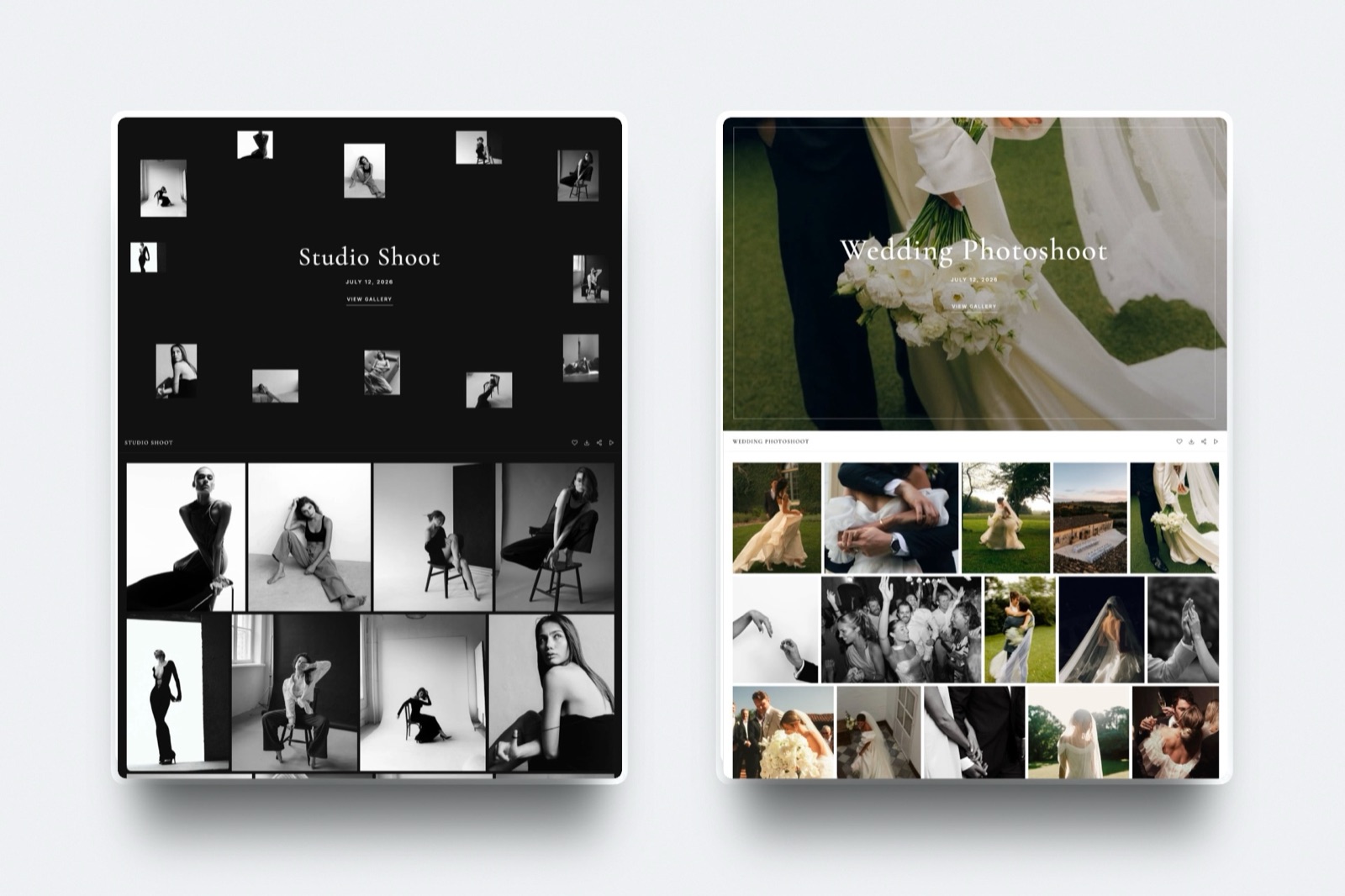
Framekit is an AI website builder with client galleries for photos and video, timestamped video review, Slides and a digital-download store in one account, and in school photography it covers the half that volume platforms treat as an afterthought: everything the school itself receives.
Class composites, staff headshots, yearbook candidates and event coverage go to an office manager or a yearbook adviser, not a parent, and those deliveries quietly decide whether the contract renews.
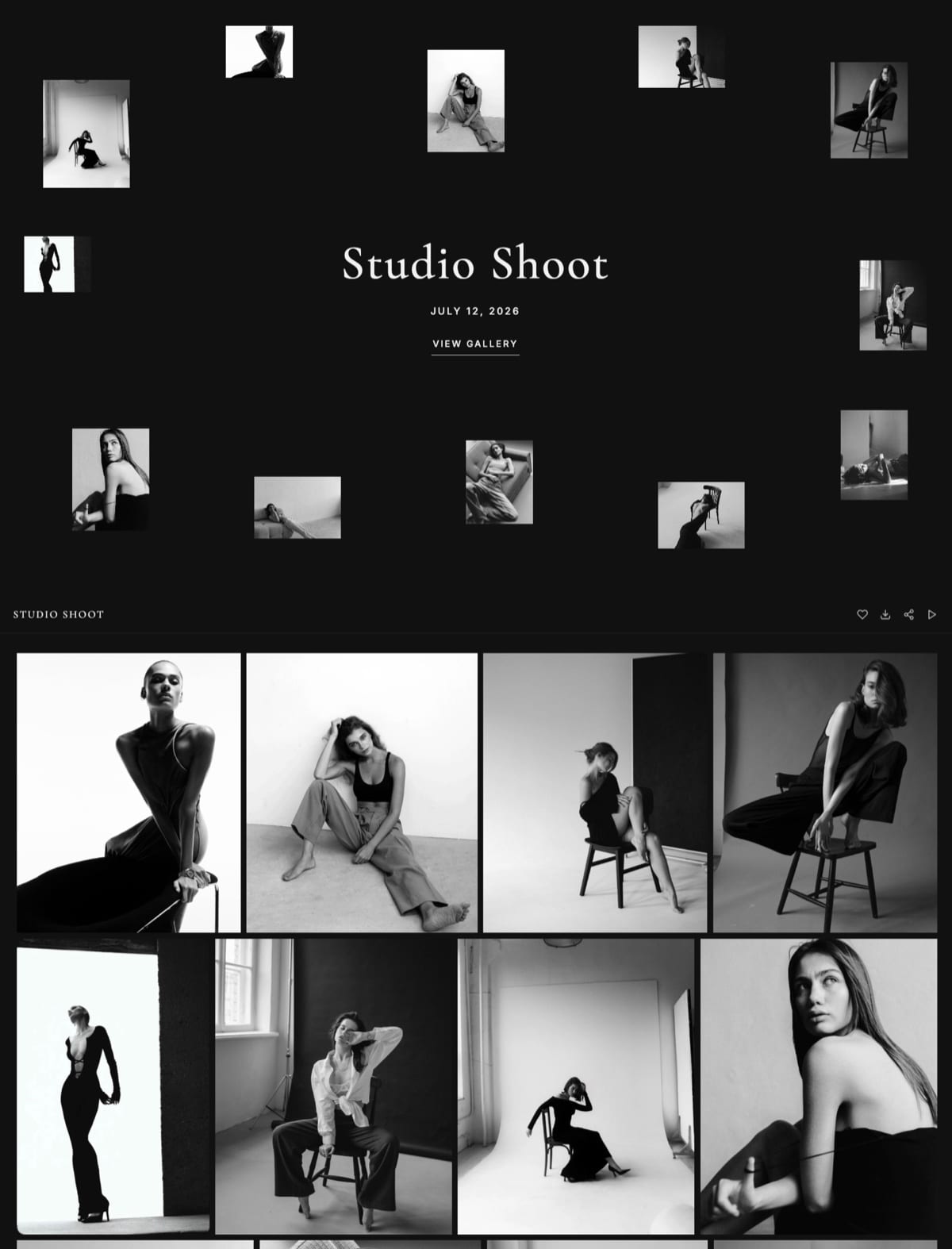
A school delivery on Framekit is one gallery per school or per term.
You can set a gallery password for the office, a separate download PIN so only the yearbook adviser pulls full-resolution files, and an expiry date with an optional reminder email before it closes.
The adviser taps a heart on candidate frames and filters to favourites, which replaces a round of "which ones did we like" emails with one shared selection. Nobody at the school has to create an account to view or download.
Best forSchool photographers who want the files a principal receives and the portfolio a district reviews at bid time to live on one domain they own.
Key features:
- Unlimited galleries on every plan including free, so one per school, per term, costs nothing extra
- Gallery password, download PIN, auto-expiry with a reminder email, and watermarks for proofs
- Favourites with a filter, which suits yearbook and composite selection rounds
- Full-set or favourites-only downloads; photo files up to 100MB each
- Video in the same gallery for assemblies, graduations and sports days, transcoded and never watermarked
- Custom domain from the $9 Starter plan, so the address a principal bookmarks is yours
The real number60 school-facing galleries across an academic year cost $0 in per-gallery or per-sale fees on any plan. Storage is pooled with your website: 10GB free, 50GB on Starter at $9 a month, 300GB on Pro at $19, and 2TB on Business at $39.
At roughly 3GB of composites, headshots and yearbook files per gallery, those 60 deliveries come to about 180GB, which Pro's 300GB holds with room left for the portfolio.
Pros:
- Deliveries to the school carry your studio's name and domain, not a vendor's
- No gallery cap and no commission, so a district costs the same to service as one class
- The bid-winning portfolio and the contract-servicing gallery are one subscription
Cons:
- No student matching, access codes, student ID lookup or picture-day automation
- No parent ordering, no package or price sheet builder, no yearbook export integration and no lab fulfilment
- No parent marketing automation, and no native mobile app
Skip it ifparent package sales are the business and you want one tool. We cannot link 600 students to 600 galleries, and forcing it would cost you an evening per school.
Verdict: Framekit is the right tool for the school-facing side and the wrong tool for picture day, so the smart setup for most school photographers is a volume platform for parents plus Framekit for the office, the adviser and the portfolio. See the wider category in our client gallery platforms guide.
4. ShootProof: Best for Keeping Your Full Markup
Our rating: 8.5/10
ShootProof charges no commission on sales on any plan, including the cheapest, and pairs that with pro-lab fulfilment, contracts and invoicing in one account.
For a school photographer with a high-margin package structure, keeping 100% of the markup is worth more than any workflow nicety.
Pricing runs on photo count rather than storage, which is the awkward part for schools: 600 students at four frames each clears a 1,500-photo plan on day one.
Free covers 100 photos, 1,500 runs $9.99 a month, 5,000 costs $19.99, 25,000 costs $31.99, and unlimited is $60, or $50 a month on annual billing, per ShootProof's plans page.
It carries a 4.9 out of 5 rating across 92 G2 reviews.
Skip it ifyou want the matching handled for you. ShootProof will sell beautifully and sort nothing.
Verdict: ShootProof is the margin pick, and the arithmetic works from surprisingly low volume. Budget the unlimited tier. If you are weighing a switch, our ShootProof alternatives guide has the comparison.
5. Pixieset: Best for Mixed Studios
Our rating: 8.1/10
Many school photographers also shoot families, seniors and headshots, and Pixieset covers all of it competently with a client experience families already recognise.
Free gives 3GB with a 15% store commission; Basic at about $10 a month raises storage to 10GB and drops commission to 0%, and Plus at about $20 gives 100GB. It has the deepest review base here at 4.7 out of 5 across 207 Capterra reviews.
For pure school volume it is the wrong shape, with no matching workflow and storage tiers that a picture day consumes quickly.
Skip it ifschools are more than half your revenue.
Verdict: Pixieset is the right general-purpose tool for a studio where schools are one line of business. It is not a volume platform and does not claim to be. Our Pixieset alternatives guide covers the next step.
6. CloudSpot: Best Bundled Admin
Our rating: 7.8/10
CloudSpot's studio manager puts contracts, invoicing and scheduling beside the gallery, which suits the paperwork-heavy reality of school contracts.
Free gives 5GB across up to 3 galleries at 15% commission, Entry is $7 a month for 15GB and up to 15 galleries, Lite is $17 for 100GB with unlimited galleries and the full suite, Pro is $34 for 500GB and Unlimited is $50, per CloudSpot's pricing page.
Paid tiers swap commission for a 2.5% transaction fee and pay out in two days rather than four.
The gallery cap on cheap tiers is the school-work trap; 15 live galleries is a fortnight.
Skip it ifyou need many galleries live at once and want to stay under $17 a month.
Verdict: CloudSpot is honest, legible and good value at Lite, but its cheaper tiers are built for a portrait studio's cadence rather than an academic year's.
7. Pic-Time: Best for Selling After the Window Closes
Our rating: 7.6/10
Pic-Time's automated campaigns, reminders and gifting flows are designed to keep selling after the initial rush, which is where school revenue leaks.
The free plan takes 15% commission, Beginner is $8 a month with 10GB, Professional $25 with 100GB and Advanced $50 with unlimited storage, and paid tiers charge 0% commission when you collect payment yourself.
Commission applies only to your markup, not production cost.
There is no volume matching, so it fits a photographer with a few schools rather than a district.
Skip it ifmatching is the bottleneck rather than conversion.
Verdict: Pic-Time is a conversion tool wearing a gallery. Useful as a second act, not as picture-day infrastructure.
8. SmugMug: Best Multi-Year Archive
Our rating: 7.2/10
Unlimited storage on every plan makes SmugMug the cheapest way to keep a decade of cohorts online, which matters when a school asks for a graduating class's photographs from year seven.
Annual pricing is $20 a month for Direct, $23.50 for Portfolio and $37 for Pro, with monthly rates at $29, $35.50 and $52; print sales carry a commission on markup commonly planned around 15%.
Its Capterra score is 3.5 across a thin sample of 11 reviews.
Skip it ifyou need a modern buying experience for parents.
Verdict: SmugMug is the archive layer, not the sales layer. Run it behind a volume platform. Our SmugMug alternatives roundup covers the trade.
9. Zenfolio: One Subscription for Site and Store
Our rating: 6.9/10
Zenfolio bundles a template website, galleries and print sales at around $9 a month for Basic, $23 for Professional and $40 for Advanced, with a flat 7% per order.
For a photographer who wants one bill and a predictable percentage, it is coherent. Its Capterra rating is 3.9 from just 14 reviews, too small a sample to lean on.
Design is the ceiling, and school bids are often won on presentation.
Skip it ifyou pitch against other studios on a portfolio.
Verdict: Zenfolio is adequate at everything and excellent at nothing, which is a defensible position at $9 a month. Our Zenfolio alternatives guide covers where people move.
10. Picflow: Best for Proofing Composites With the School
Our rating: 6.7/10
Picflow is included because school work has a proofing stage nobody talks about: composites, yearbook selections and staff pages that an administrator has to approve before print.
Picflow's per-image comment threads, annotation and tagging handle that better than any volume platform, and paid plans start at $21 a month.
It has no student matching and no parent ordering, so it can only ever be the second tool in a school stack.
Skip it ifthe school approves by email and always has.
Verdict: Picflow is a specialist for the approval stage, not a school platform. Worth knowing about when composite revisions become the thing that eats your October.
What a School Year Actually Costs on Each Model
The subscription is almost never the real cost in school photography, which is why the cheapest monthly plan regularly turns out to be the most expensive year. Here is a full academic year at $40,000 of parent order revenue plus 60 school-facing deliveries.
| Setup | Annual subscription | Fees on $40,000 | Total to the platform |
|---|---|---|---|
| GotPhoto free (12%) | $0 | $4,800 | $4,800 |
| GotPhoto Growth (9%) | $119 | $3,600 | $3,719 |
| GotPhoto Pro (7%) | $599 | $2,800 | $3,399 |
| PhotoDay (10%) | $0 | $4,000 | $4,000 |
| ShootProof unlimited | $720 | $0 commission | $720 |
| Framekit Pro (delivery only) | $228 | $0 | $228 |
Two caveats keep this honest. ShootProof and Framekit look cheap partly because they do less: neither matches students, and Framekit has no parent store at all.
And card processing of roughly 2.9% plus $0.30 per order, about $1,160 on this year, applies on top of every row where a parent pays, so it is left out of the table.
The genuine comparison is between a percentage and a flat subscription: ShootProof's $720 beats PhotoDay's 10% past about $7,200 in parent revenue and beats even GotPhoto's best 7% rate past about $10,300, winning on price and losing on workflow.
In one linepick the fee model that matches your volume, then check whether it can also serve the school.
How to Choose Your School Gallery
Answer these in order and stop at the first yes, because the school gallery decision turns almost entirely on your volume and your headcount rather than on any feature comparison you can run in a demo.
1. Do you have staff on picture day? If yes, GotPhoto, for the seats and the job management. If no, continue.
2.
Is your parent revenue above roughly $12,000 a year? If yes, compare GotPhoto Growth's 9% and ShootProof's flat 0%-commission plans against PhotoDay's 10% on your actual numbers, because at that size PhotoDay stops being the cheapest.
If no, PhotoDay, because zero fixed cost beats everything at low volume.
3. Do schools also receive composites, staff photos and yearbook assets from you? If yes, add Framekit for that half, since delivery is uncapped and free of commission and the portfolio comes with it.
4. Do administrators approve composites in rounds? If yes, add Picflow for the annotation, or accept email.
5. Do you need cohorts kept online for years? If yes, SmugMug for unlimited storage behind whatever you chose above.
Frequently Asked Questions
What is the best client gallery for school photographers in 2026?
The best client gallery for school photographers in 2026 is GotPhoto for operations with staff, because its job management and sliding 12% to 7% service fee are built for academic-year volume.
PhotoDay is the best option for solo photographers, since it charges no subscription and takes a flat 10% of each order only when a parent buys.
Framekit is the best choice for the school-facing deliveries and the portfolio that wins contracts, though it has no student matching or parent ordering.
How do school photographers match students to galleries?
Volume platforms use access codes and matching workflows so a family reaches only their own child's images, which is why GotPhoto and PhotoDay dominate school work.
General gallery tools including Pixieset, Pic-Time, CloudSpot and Framekit have no such system, so matching 600 students means manual folder organisation. This single capability is usually the deciding factor in a school platform choice.
What percentage do school photography platforms take?
Service fees in 2026 run from 12% on GotPhoto's free tier down to 7% on its $49.90 Pro plan, PhotoDay takes a flat 10% transaction fee with no subscription, and ShootProof charges 0% commission on every plan.
Card processing of about 2.9% plus $0.30 per order comes on top almost everywhere. On $40,000 of parent revenue, the difference between a 12% fee and a flat-subscription platform is more than $4,000 a year.
Is a subscription or a percentage fee cheaper for school photography?
A percentage is cheaper at low volume and a flat subscription is cheaper above it: ShootProof's $720-a-year unlimited plan beats a 10% fee past about $7,200 in annual parent revenue and a 7% fee past about $10,300.
The crossover depends on the specific tiers, so multiply your own order revenue by each percentage and add twelve months of subscription before deciding.
Photographers routinely stay on a free 12% tier years after a paid plan would have saved them money.
Do I need a separate website if my school platform hosts galleries?
Yes, because school contracts are usually awarded after a review of your portfolio and references, and volume platforms give you a gallery system rather than a marketing site.
Framekit merges both so the portfolio and the school-facing gallery share one domain, which is why it appears in a school ranking despite having no picture-day tooling.
GotPhoto vs PhotoDay: which is better for school photography?
GotPhoto is better once you have staff, because it offers five user seats on its Pro plan and job management across many schools.
PhotoDay is better for a solo photographer, because it has no subscription and no off-season cost while still handling matching, access codes and lab fulfilment.
The dividing lines are whether more than one person works your picture days and whether your parent orders clear about $12,000 a year, where GotPhoto's 9% Growth tier starts to undercut PhotoDay's 10%.
How long should school galleries stay open for parents?
Most school photographers run an ordering window of two to four weeks and then close or archive the gallery, because open-ended availability suppresses urgency and reduces order rates.
School-facing deliveries of composites and yearbook assets should stay live indefinitely. Almost every paid platform lets you set expiry per gallery, so check that setting before publishing an entire school.
Can a client gallery handle yearbook file delivery to the school?
Yes, and it is often easier than the parent side. What a school needs is a password-protected gallery with full-resolution downloads and no store, which Framekit, Pixieset, ShootProof, PicDrop and CloudSpot all handle.
The consideration is file size ceilings and whether the school's IT can reach the download without an account, which trips up tools that force registration.
What happens to my school galleries if I stop paying?
Behaviour varies and it is worth reading the terms before a season, not after.
Most platforms take galleries offline when a subscription lapses while retaining data for a grace period, and platforms with no subscription such as PhotoDay simply stop earning from you.
Keep your own archive independently of any platform, because a lapsed account should never be the reason a school cannot get last year's composites.
Are free school photography gallery plans usable?
PhotoDay's free account is genuinely usable because the whole product is free to join and monetised per order.
Other free tiers are not: 3GB on Pixieset, 5GB on CloudSpot, 10GB on Framekit and 100 photos on ShootProof will each hold a fraction of one picture day, though Framekit's free plan is enough for a few schools' composite and staff deliveries.
Use those free tiers to test the client experience, then price the paid plan you would actually need.
Final Verdict
School photography is a volume business with a relationship business bolted to the side, and the best platform depends on which side is bleeding.
GotPhoto wins overall because its staff seats and falling service fee match how school operations actually grow. PhotoDay is the better answer for anyone working alone, since it removes the fixed cost entirely.
ShootProof wins on pure margin once your parent revenue is high enough for a flat subscription to beat a percentage.
Where Framekit loses. We rank third and we are not the picture-day answer.
Framekit does not match students, does not issue access codes, has no package builder, no parent marketing automation, and no print lab, and forcing school volume through it would cost you an evening per school.
GotPhoto and PhotoDay beat us there decisively, and ShootProof will make you more print revenue than we can. What we are best at is the other half: the school-facing delivery and the portfolio that keeps the contract.
The check worth running before your next bid: open the last thing you sent a principal and ask whether it looked like a studio or like a software account. Contracts get renewed on that impression more often than on price.
Related readingthe best client gallery platforms, client galleries for event photographers, client galleries for senior photographers, and studio management tools for photographers.
Every fee, subscription and storage figure was read from the vendors' published pricing pages in August 2026 and re-verified in September 2026, and both a 600-student parent flow and a school-facing asset delivery were run on every competing platform, because school photography hides its costs in the half of the job that nobody demos.