Framekit templates
Start from a designer-made template
 Use template
 Use template
 Use template
 Use template
 Use template
 Use template
 Use template
 Use template
If you sell digital products, you have probably hit the same question: should you run sales through Lemon Squeezy (lemonsqueezy.com), or build on Framekit?
The two get compared constantly - but they are not the same kind of tool, and picking the wrong one leaves you with either a checkout and no real website, or a brand with nowhere proper to sell.
Lemon Squeezy is a checkout and billing tool. Framekit is a website builder with selling built in. That single difference decides almost everything else: where your store lives, how it looks, what you pay, and who the customer remembers afterward.
This comparison breaks down what actually matters when you sell digital products: your storefront and website, design quality, fees, tax handling, digital delivery, and performance. By the end you will know which one fits how you want to sell.
Framekit lets you sell digital products from a real, designer-quality website - free to start, no credit card.
For most creators selling digital products in 2026, Framekit is the better choice because it gives you a real, designer-quality website with selling built in - your store, portfolio, and brand in one place - with a low platform fee that drops to 0% on the Business plan.
Lemon Squeezy is better in one specific case: when you want a pure checkout with sales tax and VAT fully handled for you as a merchant of record, and you do not need a real website.
Lemon Squeezy vs Framekit: Quick Comparison
| Dimension | Framekit | Lemon Squeezy |
|---|---|---|
| What it is | AI website builder with built-in store | Checkout and billing tool |
| Real website included | Yes - full site, portfolio, blog, store | No - checkout pages and a basic storefront |
| Design control | Full, AI-designed by senior designers | Minimal - hosted checkout styling |
| Sells digital products | Yes, with automatic file delivery | Yes, with automatic file delivery |
| Sales tax / VAT | You connect your own processor | Handled for you (merchant of record) |
| Custom domain | Yes | Limited |
| Performance / SEO | Fast-loading, built-in SEO | Not a website, minimal SEO surface |
| Starting price | Free / $19 mo | Free to start, ~5% + 50¢ per sale |
| Best for | Creators who want a branded site + store | Sellers who only need checkout + tax handled |
What Is Lemon Squeezy?
Lemon Squeezy is a platform for selling digital products and software through hosted checkout. Its defining feature is that it acts as a merchant of record: it processes the payment as the legal seller and handles global sales tax and VAT compliance for you.
It supports one-time products, subscriptions, license keys, and digital file delivery, and it gives you a simple hosted storefront. What it does not give you is a real website.
There is no portfolio, no blog, no pages for your brand - Lemon Squeezy is the checkout layer, and you are expected to have a site elsewhere or rely on links.
What Is Framekit?
Framekit is an AI website builder for creative professionals and creators, with product selling built in. You generate a full, designer-quality website - homepage, portfolio, blog, contact, and store - and sell digital products directly from it.
Its AI was trained by senior designers, so the site looks professionally designed rather than templated. Checkout is Stripe-powered with automatic, secure file delivery, and Framekit's platform fee on sales drops to 0% on the Business plan.
The store is not a separate hosted page - it is part of the website you own.
Your Website and Storefront
This is the core difference. With Lemon Squeezy, your "store" is a hosted checkout and a basic storefront on their infrastructure. It works, but it is not your website, and it is not where your brand lives.
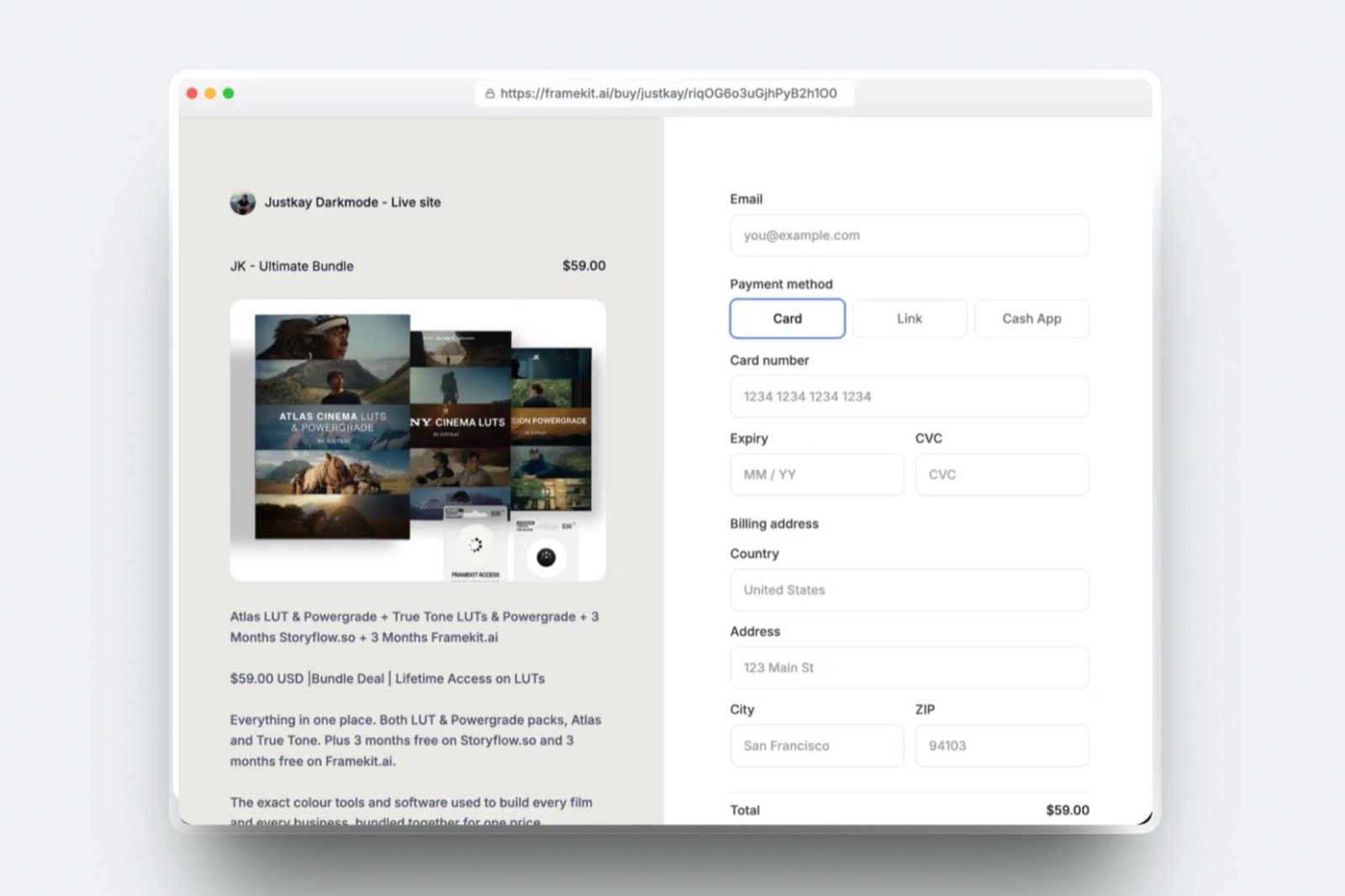
With Framekit, the store is one part of a complete website. The same site shows who you are, displays your work, runs your blog, and sells your products - all under your domain and your design. Every visitor who comes to buy also sees your brand, which compounds over time.
If you already have a great website and only need a checkout bolted on, Lemon Squeezy can fill that gap. If you do not have a site you are proud of, Framekit gives you both at once.
Design Quality and Brand
Lemon Squeezy's checkout is clean, but design control is limited - you adjust a hosted checkout, you do not design a site. Every Lemon Squeezy storefront broadly resembles every other one.
Framekit's AI was built around design from day one. Your store pages, product pages, and the website around them are generated to professional standards and stay visually consistent as you add sections.
For creators selling to a design-aware audience, that difference is the difference between looking established and looking like a generic checkout.
What the Stripe Acquisition Changed
In one lineStripe acquired Lemon Squeezy in 2024 and it still runs as its own product with its own dashboard, API and merchant-of-record model, which is the reassuring answer, though it is worth knowing who owns the thing you are building a business on.
This is the first question anyone comparing the two should ask in 2026, and most comparisons written before the acquisition do not answer it.
What did not change. The pricing, the merchant-of-record structure, the dashboard and the API all continue as before.
Lemon Squeezy announced the acquisition on its own blog and has continued shipping as a distinct product since.
What it means in practice. The infrastructure underneath is now the largest payments company in the market, which is a genuine reliability argument and not a small one for a business whose revenue arrives through somebody else's checkout.
The thing worth holding lightly. Acquired products get folded into their parent eventually more often than not, and nobody outside Stripe knows the plan.
That is not a prediction and it is not a reason to avoid the platform.
It is a reason to keep your customer list exportable and your product files somewhere that is not only inside the platform, which is advice we would give about any tool including our own.
The Fee Comparison, Done Properly
In one linealmost every comparison of these two gets this wrong, because Lemon Squeezy's 5% includes payment processing and Framekit's percentage does not, so the honest arithmetic has to add Stripe's cut to one side and not the other.
Lemon Squeezy charges a flat 5% plus $0.50 per transaction, and that figure covers processing, tax handling, fraud tooling and subscriptions.
Framekit charges 5% on Free and Starter, 3% on Pro, and 0% on Business and Enterprise, and because you connect your own Stripe account, Stripe's standard 2.9% plus $0.30 applies on top of whatever Framekit takes.
Comparing 5% to 0% without that adjustment is the error to avoid.
Here is what each actually leaves you, per sale, on three common price points.
| Sale price | Lemon Squeezy (5% + $0.50) | Framekit Free (5% + Stripe) | Framekit Business ($39/mo, 0% + Stripe) |
|---|---|---|---|
| $9 | $8.05 | $7.99 | $8.44 |
| $29 | $27.05 | $26.41 | $27.86 |
| $99 | $93.55 | $92.09 | $95.83 |
The crossover, which is the number to actually use. Framekit Business nets $0.81 more per sale than Lemon Squeezy on a $29 product, so the $39 plan pays for itself at roughly 48 sales a month.
On a $99 product the per-sale gap is $2.28 and the plan pays for itself at about 17 sales a month. On a $9 product the gap is $0.39 and you need around 100 sales a month, which is a lot of $9 sales.
The insight hiding in the low row. That $0.50 is a fixed charge, so it hurts most where the price is smallest.
On a $9 product, the flat 50 cents is worth about 5.6% on its own, which puts Lemon Squeezy's effective take above 10%.
If your catalogue is cheap products sold in volume, that fixed component matters more than the headline percentage and almost nobody models it.
And the direction it runs the other way. Below those crossover volumes, paying a percentage genuinely is cheaper, and a seller doing a handful of sales a month should not be paying $39 for the privilege of a lower rate.
Start where the arithmetic says and move when it changes.
Fees and Pricing
Lemon Squeezy charges roughly 5% + 50¢ per transaction, which includes its merchant-of-record service. There is no monthly fee - you pay as you sell.
Framekit uses plan pricing: a free plan to start, Starter at $9 per month, Pro at $19, or Business at $39. Its product-sale fee is 5% on Free and Starter, 3% on Pro, and 0% on Business, on top of standard payment processing through your connected processor.
The math depends on volume. At low volume, Lemon Squeezy's pay-as-you-go model is easy. As your sales grow, moving to the Business plan takes the platform fee to 0%, so you keep far more of each sale, and Framekit's pricing stays flat.
Taxes and Compliance
This is Lemon Squeezy's genuine strength. As a merchant of record, it calculates, collects, and remits global sales tax and VAT for you. If selling internationally and never thinking about tax compliance is your priority, that is real value.
Framekit is a website builder, not a merchant of record. You connect your own payment processor and remain responsible for your own tax obligations.
For many creators that is straightforward; if it is not, Lemon Squeezy's handling is a legitimate reason to choose it - or to use it alongside a proper website.
The Tax Question, Which May Decide This For You
In one lineLemon Squeezy is the merchant of record and Framekit is not, which means Lemon Squeezy becomes the legal seller and handles VAT and sales tax registration, collection and remittance on your behalf, while with Framekit that obligation stays yours.
This is the largest genuine difference between the two products and it is not close. We would rather explain it properly than downplay it.
What merchant of record actually means. Lemon Squeezy sells your product to the customer, and you sell to Lemon Squeezy.
It appears on the customer's statement, it is responsible for charging the right VAT rate in the customer's country, and it files and remits that tax. The compliance burden moves off you entirely.
Why that is worth real money. A creator in the UK or the EU selling digital goods to consumers abroad is exposed to destination-based VAT rules with no small-seller threshold in many jurisdictions, and US sales tax on digital goods varies state by state.
Handling that yourself means registrations, filings, and either an accountant or a tax automation subscription.
For a seller with meaningful international volume, the cost of doing it properly can comfortably exceed the fee difference calculated above.
What Framekit does instead. You connect your own Stripe account, you are the merchant, the money goes to you directly, and the tax obligations are yours.
That is better if you want direct control of your payment relationship and your payout timing, and worse if you wanted somebody else to own the compliance.
The honest conclusion. If you sell internationally and do not want to think about VAT, Lemon Squeezy is the better fit and the fee difference is a fair price for it.
If you sell mostly domestically, or you already have an accountant handling this, the merchant-of-record advantage is worth less to you and the arithmetic above starts to dominate.
The Mechanics Nobody Compares Until It Matters
In one linerefunds, chargebacks, payouts and currency all behave differently under a merchant-of-record model, and the differences only become visible on the day one of them goes wrong.
Refunds. Under a merchant-of-record model the platform processes the refund and reverses the tax it collected, which is genuinely convenient.
When you are the merchant on your own Stripe account, you issue the refund yourself and the processing fee behaviour follows Stripe's own policy rather than the platform's.
Check the current position on either side before assuming a refund is cost-free.
Chargebacks. Whoever is the merchant of record fields the dispute. With Lemon Squeezy that is Lemon Squeezy, and the platform absorbs the process. With your own Stripe account, disputes and any associated fees come to you, and you write the evidence submission.
Payouts. This one favours the direct model clearly. Money in your own Stripe account settles on Stripe's ordinary schedule directly to you.
A merchant-of-record platform is holding your money and paying it out on its own cycle, because legally it made the sale and owes you the balance.
Currency. Selling in a currency other than your payout currency incurs a conversion somewhere in the chain either way. The difference is visibility: on your own Stripe account you can see exactly where it happens.
Delivery. Both deliver files reliably, which is table stakes now. The difference is where the buyer is standing when they pay, which is the next section.
Digital Delivery and Checkout
Both platforms handle the core job well: a buyer pays, and the file is delivered to them automatically and securely. Both support digital downloads and the basics of a smooth checkout.
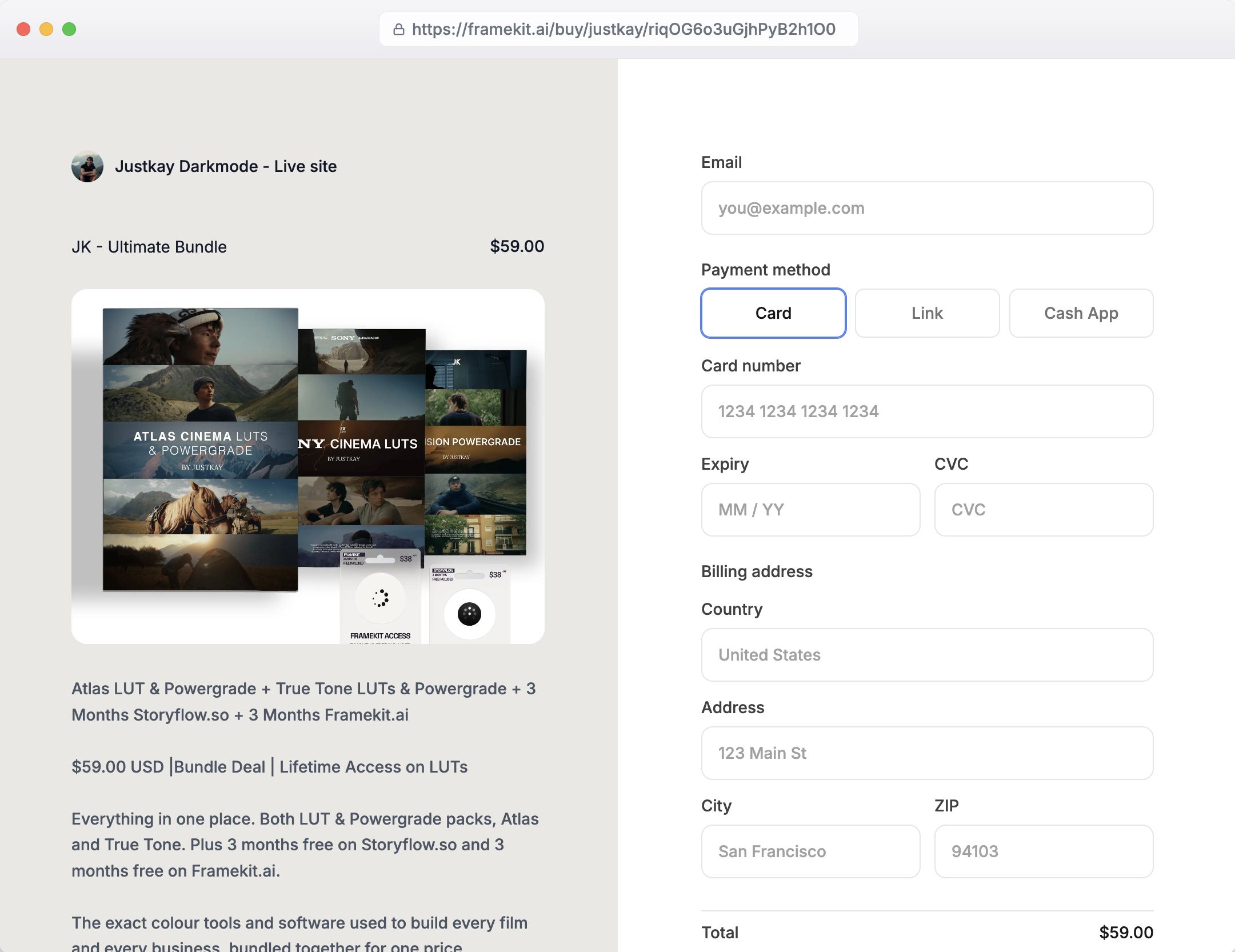
The difference is the surrounding experience. On Framekit, checkout happens inside your branded website. On Lemon Squeezy, it happens on a hosted checkout the buyer recognizes as Lemon Squeezy, not as you.

Performance and SEO
Lemon Squeezy is not a website, so there is little SEO surface - you are not ranking a storefront checkout in Google.
Framekit sites include server-side rendering, automatic sitemaps, structured data, and are built for fast-loading, performance-optimized output.
Because your store is part of a real website, product and content pages can rank and bring in buyers over time. That is traffic Lemon Squeezy alone cannot generate for you.
Can You Use Lemon Squeezy and Framekit Together?
The comparison frames these as an either-or, but for some sellers the honest answer is both. Lemon Squeezy's real strength is that it acts as merchant of record, handling global sales tax and VAT compliance on your behalf.
Framekit's strength is the website itself: a real, designer-quality storefront on a domain you own. They are not strictly mutually exclusive.
A seller who wants Framekit's site and brand, but specifically wants the merchant-of-record tax handling Lemon Squeezy provides, can build the storefront on Framekit and link out to Lemon Squeezy checkout for the products where that compliance coverage matters most.
It is not the simplest setup, and most creatives will not need it, but it is a legitimate middle path worth knowing about.
For the majority of sellers, though, the decision stays an either-or, and it comes down to one question: whether you are buying a checkout or a website. The next section is how to make that call.
Who Should Choose Which in 2026
Choose Framekit if you want a real, designer-quality website with selling built in - one place for your brand, your work, and your products - and you want to keep more of each sale with a low platform fee that reaches 0% on the Business plan.
This fits the large majority of creators and solopreneurs.
Choose Lemon Squeezy if you specifically want a pure checkout, you want sales tax and VAT fully outsourced through a merchant of record, and you genuinely do not need a real website around your products.
For most creators, the website is not optional - it is the brand. That is why Framekit is the stronger default.
Frequently Asked Questions
Is Framekit better than Lemon Squeezy?
For most creators selling digital products, yes. Framekit gives you a real, designer-quality website with selling built in and a platform fee that drops to 0% on the Business plan, while Lemon Squeezy gives you a checkout without a website.
Lemon Squeezy wins only when your priority is outsourced tax handling and you do not need a site.
What is the main difference between Lemon Squeezy and Framekit?
Lemon Squeezy is a checkout and billing tool that acts as a merchant of record. Framekit is a website builder with product selling built in. Lemon Squeezy gives you a way to take payments; Framekit gives you a full branded website that also sells.
Does Framekit handle sales tax like Lemon Squeezy?
No. Lemon Squeezy acts as a merchant of record and handles global sales tax and VAT for you. Framekit is a website builder - you connect your own payment processor and remain responsible for your own tax obligations.
If outsourced tax handling is essential, that is Lemon Squeezy's genuine advantage.
Which is cheaper, Lemon Squeezy or Framekit?
It depends on volume. Lemon Squeezy charges about 5% + 50¢ per sale with no monthly fee. Framekit's product-sale fee starts at 5% (Free and Starter), drops to 3% on Pro, and reaches 0% on the flat $39/month Business plan.
At higher sales volume, moving to Business keeps significantly more of each sale, because a flat monthly fee beats a percentage that never falls.
Can I sell digital products on Framekit?
Yes. Framekit has product selling built in - you sell digital products directly from your own website, with Stripe-powered checkout and automatic, secure file delivery to buyers after purchase.
Do I get a real website with Lemon Squeezy?
No. Lemon Squeezy provides hosted checkout and a basic storefront, not a full website. You do not get a portfolio, blog, or branded pages. For a real website you need a separate site builder - or a tool like Framekit that includes both.
Is Lemon Squeezy still running after the Stripe acquisition?
Yes. Stripe acquired Lemon Squeezy in 2024 and it has continued operating as a distinct product with its own dashboard, API and merchant-of-record model through 2026, as announced on Lemon Squeezy's own blog.
The practical read is that the infrastructure underneath is now considerably larger, which is a reliability argument.
The sensible caution, which applies to any acquired product and to our own, is to keep your customer list exported and your product files stored somewhere other than only inside the platform.
Which is actually cheaper, Lemon Squeezy or Framekit?
It depends on volume, and the comparison is usually done wrong because Lemon Squeezy's 5% plus $0.50 includes payment processing while Framekit's percentage does not, so Stripe's 2.9% plus $0.30 has to be added to the Framekit side.
Done properly, Framekit Business nets about $0.81 more per sale on a $29 product, so its $39 plan pays for itself at roughly 48 sales a month. On a $99 product the crossover is about 17 sales a month.
Below those volumes, Lemon Squeezy is cheaper.
Does Framekit handle VAT and sales tax like Lemon Squeezy?
No, and this is the biggest real difference between them. Lemon Squeezy is the merchant of record, so it becomes the legal seller and registers, collects and remits VAT and sales tax for you.
Framekit is not a merchant of record: you connect your own Stripe account, you are the merchant, and the tax obligations stay with you.
If you sell digital goods internationally and do not want to manage destination VAT, that alone is a strong reason to choose Lemon Squeezy over us.
Can I use Lemon Squeezy and Framekit together?
Yes, and for some sellers it is the right answer rather than a compromise. Framekit builds and hosts the site your buyers arrive at, and Lemon Squeezy handles the checkout and the tax compliance behind a link from it.
You pay for both, and you accept a handoff between two brands at the moment of purchase, but you get a site that looks like your work and a merchant of record handling the paperwork.
That combination is worth considering if international VAT is your constraint.
Final Verdict
Lemon Squeezy and Framekit get compared often, but they solve different problems. Lemon Squeezy is an excellent checkout with real strength in tax handling. Framekit is a real website with selling built in.
For most creators in 2026, the website is the brand - and a checkout with no website leaves the most important asset unbuilt. Framekit is the better choice if you want a designer-quality site and store in one, with a platform fee that drops to 0% on the Business plan.
Choose Lemon Squeezy only if you need a pure checkout with outsourced tax and no site.
For more, see the best Lemon Squeezy alternatives, the 12 best free product-selling tools, and the best AI website builders.
Lemon Squeezy's merchant-of-record terms and fees were checked against its own pricing page.
_Re-verified July 2026: the Stripe acquisition added, the fee comparison rebuilt so that payment processing is counted on both sides, and the brand name corrected to Lemon Squeezy._